We sell what we run.
We stopped building contractor software halfway through — because using AI to write more apps is automating the past. That story is on the About page. Then we rebuilt our own operation the way we'd rebuild yours: the business brain at the center, agents by department around it, each running with our standards and our approval gates. They own outcomes, not tasks — and the owner stays the CEO. Here's the operation — what runs today, and what's being built now, labeled exactly that way.
The business brain
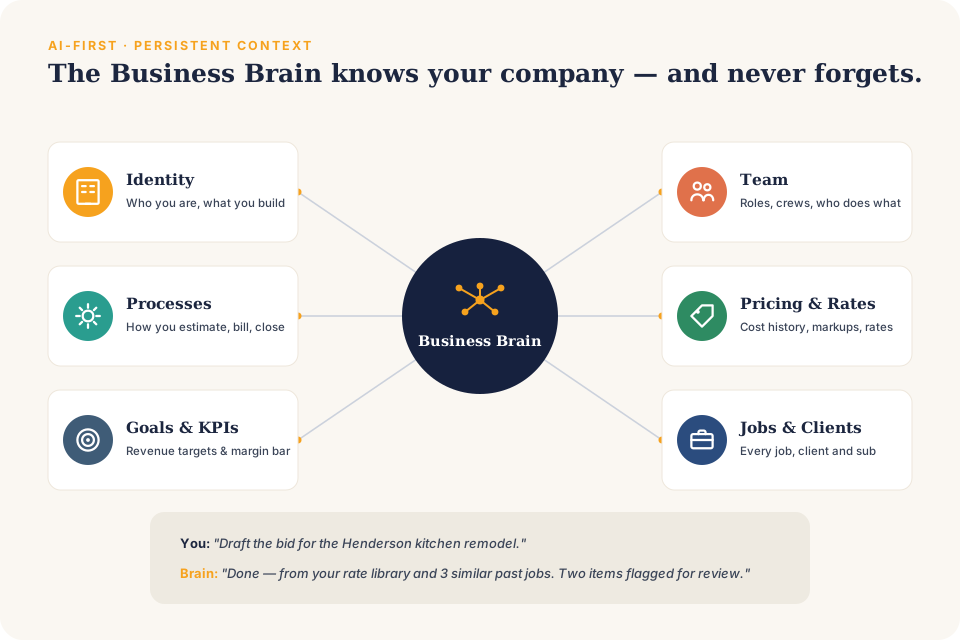
The center of the whole operation: AI with persistent context — wired into our calendar, email, CRM, ad account, and books, and loaded with 14 years of contractor coaching IP: what we've learned inside 600+ contractor businesses since 2012. It doesn't answer like a chatbot; it answers like someone who knows the business. That's the difference between the Toy and the Business Brain — see your whole business in real time. A CEO-level dashboard is being built now — we'll say so plainly rather than pretend it's already there.
Marko — our marketing agent
Runs the ads the way a CMO would: he watches the funnel daily, traces every booked sales call back to the exact ad that produced it, and reports cost per client — ad by ad, not "the campaign did fine." When an ad stops earning its spend, the data says so before the budget notices. Every piece of copy and every dollar of spend still gets a human yes before it goes anywhere.
Simon — our engineering agent
Builds and maintains our software — the collectors that pull our numbers every morning, the dashboards we run the business from, the tools behind this site. He works from a spec, plans before he builds, and stops for a human decision before anything hard to undo. It's the same discipline we install for clients: standards first, approval gates always.
Agent Prime — our office manager agent (being built now)
The next hire is an agent, and we'll show you the build as it happens. On his roadmap: QuickBooks and Stripe, a financial dashboard, monthly cashflow and bookkeeping, ongoing training for the other agents through our knowledge base, automated lead response, and the booking confirmation and reminder emails. None of that is running yet — this card flips to present tense when it is, and not a day before.
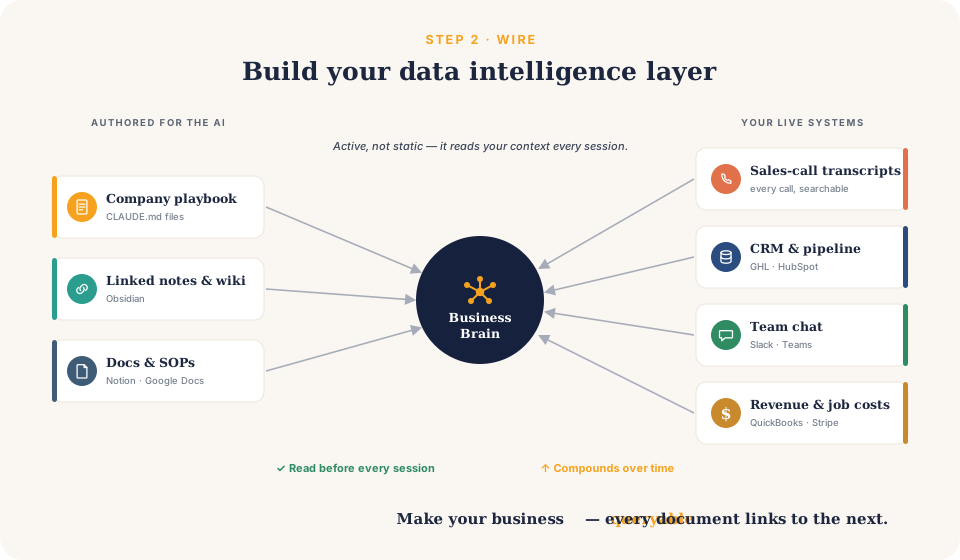
One thing we'll say before you say it: our shop doesn't pour concrete. A coaching office has no crews, no jobsites, no change orders. What it has is the same back-office disease every contractor has — estimates to chase, invoices to stage, numbers scattered across systems, chase-and-remind work eating the week. The demo proves the architecture: persistent context, agents on the busywork, approval gates on everything. Mapping it onto a contractor's nine functions — estimating, scheduling, job costing, the field — is precisely what the AI Opportunity Assessment does, in your operation, on your numbers.
Don't take the paragraph's word for it — ask for the screen.
On the Assessment Call we'll show you the ad-attribution dashboard and the agents running, live. No competitor in this niche demos their own AI-first operation.
14 years. 600+ contractors. Only contractors.
The Contractors Coach has coached construction contractors — and nobody else — since 2012. We used to put an average on this page; we took it out, because the honest version is better told by name. Here are real clients, in their own trades, with the numbers they say on camera — watch them tell it themselves, and we're 5.0★ on Yelp:
- James Kint — AWT Construction (general contracting): grew from $1M to $50M in annual revenue, to a team of 180.
- Zali & Tisza Lorincz — ZLC Corporation (general contracting): $500K to $5.5M in annual revenue.
- Gavin Burke — Burke Builders (general contracting): revenue up 300%, and profit margins doubled — the scoreboard that actually matters.
- Mike Chavez — Mike Chavez Painting (painting): $300K to $1.2M in revenue in two years.
- Jason Krist — Krist Electric (electrical): sales up 4× over four years.
Read that attribution carefully, because we mean it: those are coaching-division results — the track record behind this new AI division, not AI-client results. The AI practice is new, and we won't dress up one division's numbers as the other's. What the coaching years actually bought us is the thing the AI work runs on: 14 years inside contractor businesses — how the estimating really happens, where the change orders really die, what the owner's week really looks like. That's the map a generalist AI consultant doesn't have and can't shortcut.
And before the coaching years: 10 years at Oracle and SAP, building process automation for multi-billion-dollar companies. This isn't our founder's first time wiring intelligence into a business's real systems — it's his first time doing it for businesses his own size, where the payoff lands in the owner's pocket instead of a quarterly deck.
Here's why that history is the whole ballgame: the hardest step of AI implementation is extracting how the business actually works — out of the owner's head, the estimator's habits, and the office's unwritten routines, into something an AI can run. We've been doing exactly that with contractors for 14 years; our coaching program's 9 Systems are, in plain terms, SOPs. An AI firm that has never documented a contractor's operation has to learn that craft on your dime. We already own it.
We tell you this plainly because you've heard enough vendor math.
Where the +$250–300K number comes from
A model, not a promise. The scoreboard we run everything on is Profit per Employee — same crew, more profit. The model below is ours; every input is third-party, and the AI Opportunity Assessment exists to replace the model with your real figure. No outcome is guaranteed — that's why the assessment comes first.
The frame: it's $10M-company math — a $10M contractor running around 10% margin, roughly $1M of profit. The model says re-engineering that operation around AI recovers 2–3 points of margin, worth an estimated +$250–300K of profit per year — the same crew producing meaningfully more profit per employee. Those points come from three places, each anchored to third-party research:
- Change orders that never became invoices. Dodge Construction Network research (with Clearstory, 2026) found 77% of specialty contractors have written off change-order work as bad debt. One contractor's own estimate of his own losses: $200K over two years. Catching even a fraction of that drift on a $10M operation is measured in tens of thousands per year.
- Office capacity burned on repetitive work. Smartsheet's Automation in the Workplace survey found workers spend roughly a quarter of the workweek on manual, repetitive tasks; McKinsey Global Institute finds about 30% of activities in most occupations are automatable with existing technology. The arithmetic is yours to run: on a $1M office payroll, a quarter of the workweek is ~$250K/yr of capacity doing chase-and-remind work.
- Bids and leads that die of slowness. The MIT/InsideSales Lead Response Management study (2007, inbound sales leads) found responding in 5 minutes vs 30 makes you ~21x more likely to qualify the lead; Harvard Business Review (2011) found the average company takes 42 hours. Every unanswered estimate and unsent bid is revenue handed to a competitor.
Then the valuation bridge — this is where the accountants' word for profit, EBITDA, takes over, because acquisition multiples are written in it: private-market M&A data puts small construction company sale multiples at roughly 3–6x EBITDA, best-run firms at the top of the range (First Page Sage; Peak Business Valuation) — so an estimated +$250–300K of sustained EBITDA is roughly $1.0–1.8M of company value at the 4–6x well-run firms command.
What the model is not: a guarantee, a client result, or an average of anything. It's the estimate the assessment is designed to replace — component by component, from your books. A $4M shop gets $4M math, and if your math doesn't work, the blueprint says so.
Every third-party stat carries its source. Every number of ours is labeled ours.
This niche is drowning in "45% more bids won" claims with no author. So here is every statistic we use anywhere on this site — what it says, exactly where it comes from, and when it's from. Our own numbers (the $250–300K model, the coaching track record) are labeled as ours and shown with their basis. Check us against any other AI vendor's website.
| The claim we make | The source |
|---|---|
| Fewer than 1 in 3 construction projects finishes within 10% of budget. | KPMG Global Construction Survey, 2015 — a survey of ~100 large project owners and E&C firms; we quote it as industry-wide context ("even the big firms miss"), not as a small-contractor measurement |
| 77% of specialty contractors have written off change-order work as bad debt. | Dodge Construction Network / Clearstory, Specialty Contractor Change Order Report, 2026 |
| Respond to a lead in 5 minutes instead of 30 and you're 21x more likely to qualify it; the average company takes 42 hours to respond. | MIT/InsideSales Lead Response Management study (2007) · Harvard Business Review (2011) — studies of inbound/online sales leads; we apply them to lead response and estimate chasing, and the speed-to-lead physics is the point |
| Small construction companies sell at roughly 3–6x EBITDA, best-run firms at the top of the range — the valuation bridge in our "estimated +$250–300K ≈ $1.0–1.8M of company value" $10M-company model (full build-up above). | First Page Sage · Peak Business Valuation |
| When the US Census first measured AI use in 2023, only about 1 in 100 construction firms used it to produce goods or services — the lowest of any industry. | US Census Bureau, Business Trends and Outlook Survey (working paper) |
| Construction still runs at roughly half the national AI adoption rate. | US Census Bureau, BTOS (2026 report) |
| Contractors reporting measurable business impact from AI went from 17% to 38% in one year. (A vendor survey — we name it and weigh it accordingly, and never let it stand alone: RICS finds 78% of construction organizations have nothing beyond pilots.) | BuildOps commercial-contracting report, 2026 (via ForConstructionPros) · RICS, AI in Construction report, 2025 |
| Generalist AI consultancies commonly quote five figures for an initial assessment comparable to our $1,500–$5,000 AI Opportunity Assessment. (One published example, not a market survey — and cheaper checklist-style diagnostics exist too; we compete on deliverable depth, not price alone.) | Dan Cumberland Labs, published rate card ($15,000–$30,000 initial assessment) |
| Named coaching clients report results on camera: $1M→$50M (AWT Construction), $500K→$5.5M (ZLC Corporation), revenue +300% with profit margins doubled (Burke Builders), $300K→$1.2M in two years (Mike Chavez Painting), sales 4× in four years (Krist Electric). | The Contractors Coach — client-results page (on-camera testimonials) · 5.0★ on Yelp — coaching-division results, named and self-reported on camera; individual results vary, and they are never presented as AI-client results. |
Two honesty notes we hold ourselves to on this page and everywhere else. First: the 1-in-100 Census figure is from 2023, the first year it was measured — we never present it side-by-side with newer adoption numbers, because they come from different survey questions in different years. Second: the contractor quotes on this site come from public industry forums. They're the industry's voice, and we label them that way every time — they are not our clients and not testimonials. When we have AI-client results worth publishing, they'll appear here with the same labeling discipline.
Couldn't a competitor just copy this page?
They could copy the layout tomorrow. Here's what they can't copy.
- The 14 years. A track record inside 600+ construction businesses since 2012 can't be spun up for a landing page. Every AI consultancy in this niche is new — the question is what they did before. Our answer is: this industry, only this industry, for 14 years — and a decade of enterprise process automation at Oracle and SAP before that.
- The confession. We walked away from our own software revenue mid-build because it was the wrong thing to sell you. A claim like that is easy to fake and easy to verify — which is exactly why nobody fakes it. The full story is on the About page.
- The live demo. A competitor can write "we use AI too." What they can't do is put their own ad-attribution dashboard, their own engineering agent, and their own business brain on your screen and let you ask it questions. The demo is us — and it's offered on every Assessment Call, before you've paid us anything.
- The restraint. Any vendor could adopt "every third-party stat carries its source, and every number of ours is labeled ours." But then they'd have to delete most of their website. The unattributed percentages this niche runs on don't survive this rule — that's the point of the rule.
Proof you can check. That's the whole page.
Ask for the demo on the Assessment Call.
Book a free 30-minute AI Assessment Call. We'll show you our own AI-first operation running, re-size the scoreboard math to your revenue and your books, and tell you straight whether the AI Opportunity Assessment is worth it for your operation — including "not yet." If it isn't a fit, you'll know in 30 minutes — not after a $30,000 generalist consulting engagement.
The assessment calendar has limited slots — and the bigger clock isn't ours, it's your market's.
Not ready for the full assessment? Start small: build your AI Business Brain — a CEO dashboard on your own numbers.
If the assessment shows the math doesn't work for your operation, we'll tell you that in plain English and shake your hand — the blueprint is yours to keep either way.