“Intelligence should replace unnecessary struggle.” — paraphrasing Sun Tzu, The Art of War
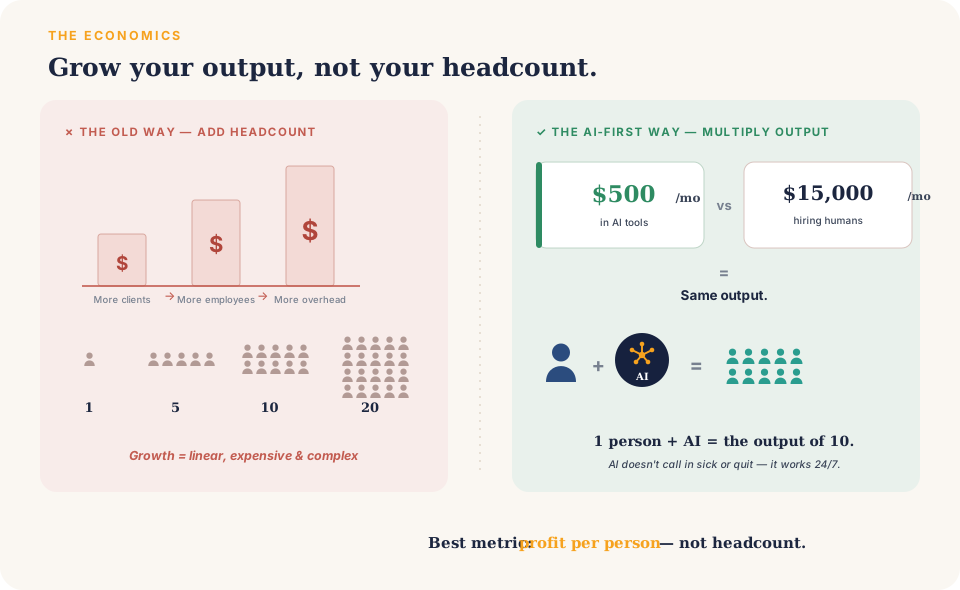
Same crew. More profit.
Re-engineering a $10M contractor around AI is worth an estimated +$250–300K in profit per year. That's $10M-company math — the AI Opportunity Assessment re-runs it on your business — and here's exactly where the number comes from.
The new scoreboard for an AI-First Contractor: Profit per Employee.
Book a Free 30-Minute AI Assessment CallNot ready for an assessment? Start small — build your AI Business Brain with a CEO Dashboard.
$250K–$300K increased profit. No new hires. No need to rip and replace software. At 4–6x profit multiples, this increases the net value of a well-run contractor business by $1.0–$1.8M (First Page Sage; Peak Business Valuation).
Stop automating the past.
Most contractors use AI to do the same paperwork faster. That's automating the past. AI is not another app to buy — it's a layer of high intelligence you re-engineer the business around.
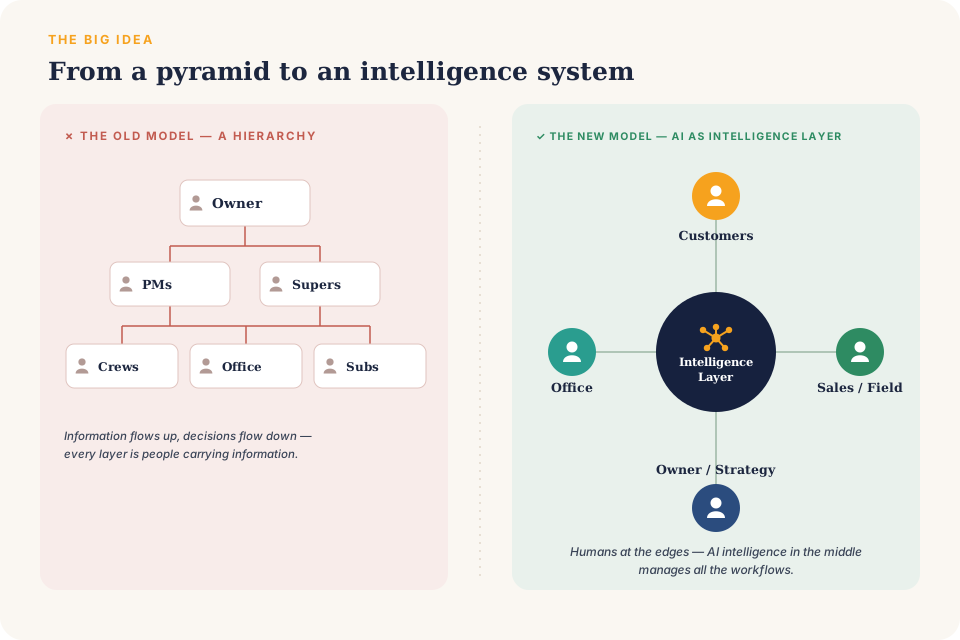
There are three ways contractors use AI today, and nearly everyone is stuck at level one.
The Toy
ChatGPT for answers, emails, proposals — some even use it for quick takeoffs. Useful, cheap, but it moves nothing on the scoreboard. This is where nearly every contractor is right now.
The Coding Tool
Using AI to build more apps and dashboards. It feels like progress, but it's catching up with what successful businesses did starting in 2010 — automating the way the business already works. We know, because we stopped doing exactly this halfway through a build. That story is on the About page.
The AI-First Contractor
This is what the dominant contractors using AI will look like. AI with persistent context that sees your whole business in real time (not another app or software) — a layer of intelligence over the entire operation. The AI-First business is built in three parts:
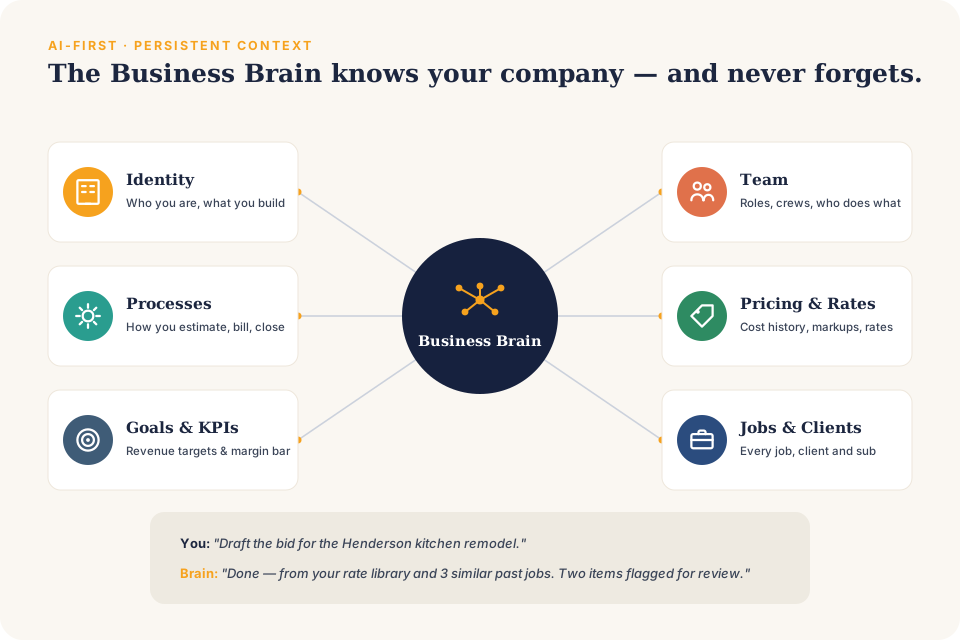
1. AI as the business brain
One brain, wired into the systems you already run — estimating sheets, contracts, schedules, QuickBooks, calls, email, CRM — so you see your whole business in real time instead of carrying it in your head.
2. AI agents alongside your employees
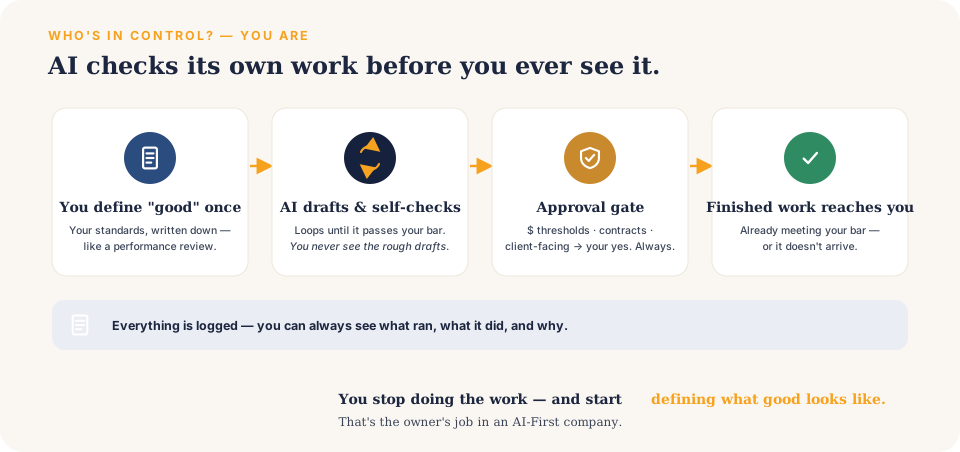
One chases the estimates nobody answered. One drafts the change-order paperwork the day the change happens. One stages invoices from job costs. Each runs with your standards and your approval gates — they own outcomes, not tasks, and your people keep the judgment calls. Goal: make your employees 2x–5x more productive. The owner stays the CEO. Always.
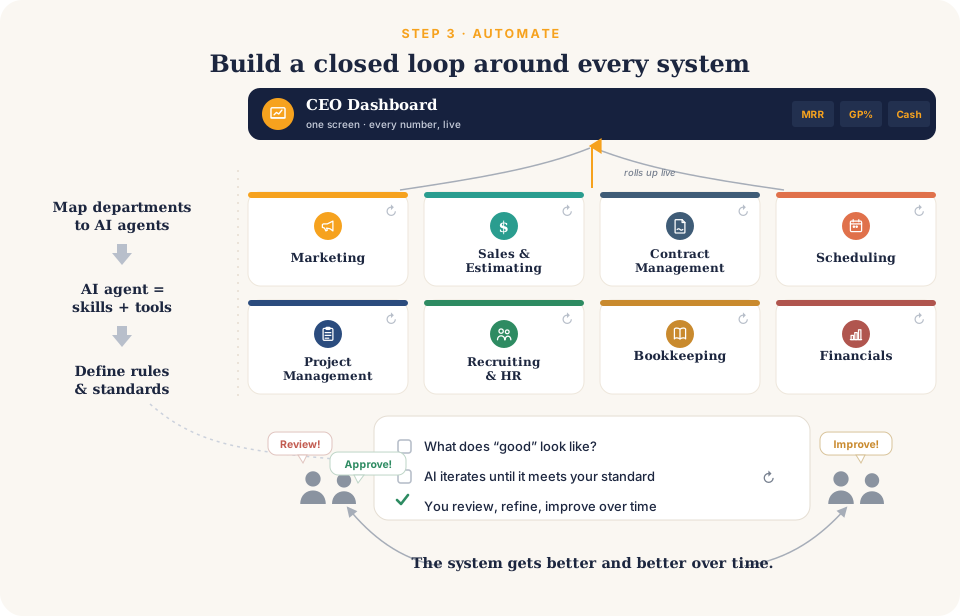
3. AI uses the software you have
No rip-and-replace. AI works through the tools you already own — and builds automations to fill the gaps between them. The result: a drastically lower cost to run the business.
What does this do to the scoreboard?
The scoreboard is Profit per Employee.
Two levers:
- win more of the work you bid,
- run more volume with the crew you've already got.
Same crew. More profit.
Where does a contractor's profit actually go?
For most $2M–$20M contractors it leaks out in three places: bids that misprice the work, change orders that never get billed, and estimates that never get out the door. Here's each one — in the industry's own words, with a dollar figure attached.
Bid: 30%. Bank: 5%.
1. The leak you can't find
"I was getting margin percentages in the 30s and 40s. Our actual margin is 5%. There clearly must be some sort of leak somewhere." — cabinet & countertop shop owner, r/estimators (industry voice, not a client)
The bid says 30%. The bank account says 5%. The difference is scattered across mis-coded hours, forgotten material orders, and invoicing that happens "when we get to it." Industry-wide, fewer than 1 in 3 construction projects finishes within 10% of budget (KPMG Global Construction Survey, 2015 — a survey of large project owners: even the big firms with full accounting departments miss).
$200K given away
2. The free work you never billed
"The first two years of my self employment I estimate I 'gave away' over $200k in unbilled change orders." — self-employed contractor, r/Contractor — his own estimate of his own losses (industry voice, not a client)
He's not alone: Dodge Construction Network research found 77% of specialty contractors have written off change-order work as bad debt. That's not a process problem. That's payroll walking out the door.
42 hours to answer a lead
3. The bid ceiling — and a race you can only win by mistake
"My brain always has 3 or 4 projects running at once." — contractor-owner, r/Construction (industry voice, not a client)
The business runs on the owner's head — so bid volume is capped by the owner's hours. Estimators describe the same wall: "like a chicken running around with its head cut off." And the race itself is broken. In one estimator's words: "The only time someone is winning the job is when they have made a mistake."
Every bid you don't get out is revenue handed to a competitor, and speed compounds it: respond to a lead in 5 minutes instead of 30 and you're 21x more likely to qualify it (MIT/InsideSales Lead Response Management study, 2007 — a study of inbound sales leads; the speed-to-lead physics is the point) — while the average company takes 42 hours (Harvard Business Review, 2011). The first contractor in your market whose estimating runs on AI changes the math — then their number is the bid you're competing against instead of the bid you're placing.
Want this math run on your business? That's the assessment's whole job.
Why would a contractor trust us on AI?
Because we've spent 14 years inside contractor businesses. Before that, the founder spent 10 years automating operations for multi-billion-dollar Fortune 500 businesses. Here's each claim, plainly.
14 years. 600+ contractors. Only contractors.
The Contractors Coach has coached construction contractors since 2012 — and the results are named, not averaged: AWT Construction grew $1M→$50M, ZLC Corporation $500K→$5.5M, Burke Builders doubled its profit margins. Coaching-division results, individual results vary — the track record behind this new AI division, not AI-client results. Watch them tell it →
The confession — and the live demo
We stopped building our own contractor software halfway through, because using AI to write more apps is automating the past. Then we rebuilt our own company AI-first: a business brain wired into our real systems, agents by department, a human approving every send — and a CEO-level dashboard being added to that brain this month. We'll show you live on the call. Our shop doesn't pour concrete — but the back office is the same disease: estimates, invoices, chase-and-remind. Same architecture, mapped to a contractor's nine functions. No competitor in this niche demos their own AI-first operation.
The model is ours. Every input is third-party.
The +$250–300K hero number is our model — and we publish it component by component, with a source on every input: see the build-up. Private-market M&A data puts small construction company sale multiples at roughly 3–6x EBITDA, best-run firms at the top of the range (First Page Sage; Peak Business Valuation). Dodge Construction Network, KPMG, and the US Census supply the rest. Every third-party stat carries its source; every number that's ours is labeled as ours and shown in full.
Your size is your speed.
A $2M–$20M contractor can become AI-first faster than any big GC, because you can decide this week what they'd spend a year approving. A big GC needs three committees and eighteen months to change how they estimate. You need a decision and a quarter. At your size, the whole company can be re-engineered around AI while a larger competitor is still scheduling the kickoff meeting.
That's not a weakness. It's the whole advantage.
The questions contractors actually ask us
Straight answers, including the ones that end with "then don't hire us."
How much does this cost?
The AI Opportunity Assessment is $1,500–$5,000, priced by the size of your team:
- Level 1 — $1,500: the owner interview
- Level 2 — $2,500: owner + up to 2 team members
- Level 3 — $4,000: owner + up to 4 team members
- Level 4 — $5,000: owner + up to 6 team members
Levels are based on the size of your team — how many functions we're looking to automate by conducting the relevant interviews to create the implementation blueprint. Delivered over Zoom. For comparison: generalist AI consultancies commonly quote five figures for a comparable initial assessment (one published example: Dan Cumberland Labs’ rate card, $15,000–$30,000), and cheaper checklist-style diagnostics exist too — compare deliverables, not invoices. Now run it against the other side of the ledger: one contractor's own estimate of his unbilled change orders was $200K over two years. The expensive thing is the leak, not the map.
Implementation is scoped only from the assessment blueprint — never quoted blind. Builds start at $15K; most first phases land $15–25K, because phase one is only the fastest-payback fixes, every number is approved before anything starts, and you can stop after any phase. The assessment is the product, not the pitch.
Why not just buy Procore's AI or another tool?
A platform can only optimize the workflows that live inside it — it doesn't get the business out of your head. The four-channel redesign — sorting every workflow into what runs itself, what runs with your sign-off, what your people do faster with AI, and what stays fully human (explained here) — is about the business: who decides, what runs itself, what stays human. Not any one tool. Point tools bought one at a time is automating the past, one subscription at a time.
My nephew is good with AI — why would I need you?
Great — keep him. He can run the tools. What he can't do is interview the people who run your operation, put a dollar figure on every leak, and rank the fixes by payback — that takes 14 years inside construction businesses, not a ChatGPT subscription. The assessment's blueprint is one anyone can execute, including your nephew — and it's yours to keep even if we never build a thing.
The mechanic is common. The map of your business isn't.
We're not techy. Does that matter?
Good. Techy isn't the job — profitable is. You don't learn new software; AI wires into what you already run: your estimating sheets, contracts, schedules, QuickBooks, calls, email, CRM. If you can read a job-cost report, you can read our blueprint.
Is this the same as an "AI audit"?
Some call this an AI audit. We don't — audits check compliance; assessments find upside. The AI Opportunity Assessment maps your processes, puts a dollar figure on every leak, sorts every workflow into four channels, and hands you a ranked implementation blueprint that's yours to keep — even if we never build a thing.
Isn't AI mostly hype?
Most of it is — that's why we sell an assessment, not a promise. Here's what isn't hype: when the US Census first measured AI use in 2023, only about 1 in 100 construction firms used it to produce goods or services — the lowest of any industry — and construction still runs at roughly half the national adoption rate (US Census BTOS). Meanwhile, contractors reporting measurable business impact from AI more than doubled in a single year — 17% to 38% (BuildOps, 2026 — a vendor survey, so weigh it accordingly) — while RICS finds 78% of construction organizations have nothing beyond pilots. Both are true at once: the crowd hasn't moved, and the early movers are already collecting.
Your competitors playing with ChatGPT are at level one: the Toy. The scoreboard doesn't move until AI runs in the background of the business — with your standards, and your approval on every gate. The truth is, if the assessment shows the math doesn't work for your operation, we'll tell you that too.
Are we too small for this?
Backwards — your size is your speed. A big GC needs three committees and eighteen months to change how they estimate. You need a decision and a quarter. At $2M–$20M, that's not a weakness. It's the whole advantage.
Who's on the hook if the AI is wrong?
You are — which is why nothing we install acts without standards and approval gates. Agents own outcomes, not authority. Your people approve the calls that matter; the AI does the busywork. The owner stays the CEO. Always.
What happens on the free 30-minute AI Assessment Call?
We tell you straight whether the assessment is worth it for your operation — including "not yet" — and we re-size the scoreboard math to your business and your books. The $250–300K model is built on a $10M contractor and we say so: a $4M shop gets $4M math. If it isn't a fit, you'll know in 30 minutes instead of $30,000.
The ladder, stated plainly
- The Assessment Call — 30 minutes, free. A mutual straight answer. You qualify us the way you'd qualify a sub.
- Start small (optional) — build your AI Business Brain with a CEO Dashboard.
- AI Opportunity Assessment — $1,500–$5,000, priced by the size of your team: Level 1 ($1,500) is the owner interview; Level 2 ($2,500) adds up to 2 team members; Level 3 ($4,000) up to 4; Level 4 ($5,000) up to 6 — how many functions we're looking to automate by conducting the relevant interviews. Delivered over Zoom. You get the process map, every leak quantified in dollars, the tool/data map, the four-channel workflow redesign, and a ranked phased blueprint. Yours to keep.
- Implementation — $15K+, scoped only from the blueprint, never quoted blind; most first phases land $15–25K, low-hanging fruit first, every number approved before anything starts. You can stop after any phase.
- Maintenance retainer — once the build is live. Optional — the build runs without it, and the blueprint is written so your own team (or an office manager we train) can take it over.
Most firms we talk to should stop at rung three and digest — the blueprint tells you, with numbers, whether the next rung is worth it.
One honest note on timing: contractors reporting measurable business impact from AI went from 17% to 38% in one year (BuildOps, 2026 — a vendor survey), while RICS still finds 78% of construction organizations have nothing beyond pilots — both are true at once. The assessment calendar has limited slots — and the bigger clock isn't ours, it's your market's.
Not ready for the full assessment? Start small — build your AI Business Brain with a CEO Dashboard. The dashboard lets you see the business in real time. The assessment tells you, in dollars, what re-engineering it is worth.
If the assessment shows the math doesn't work for your operation, we'll tell you that in plain English and shake your hand — the blueprint is yours to keep either way.